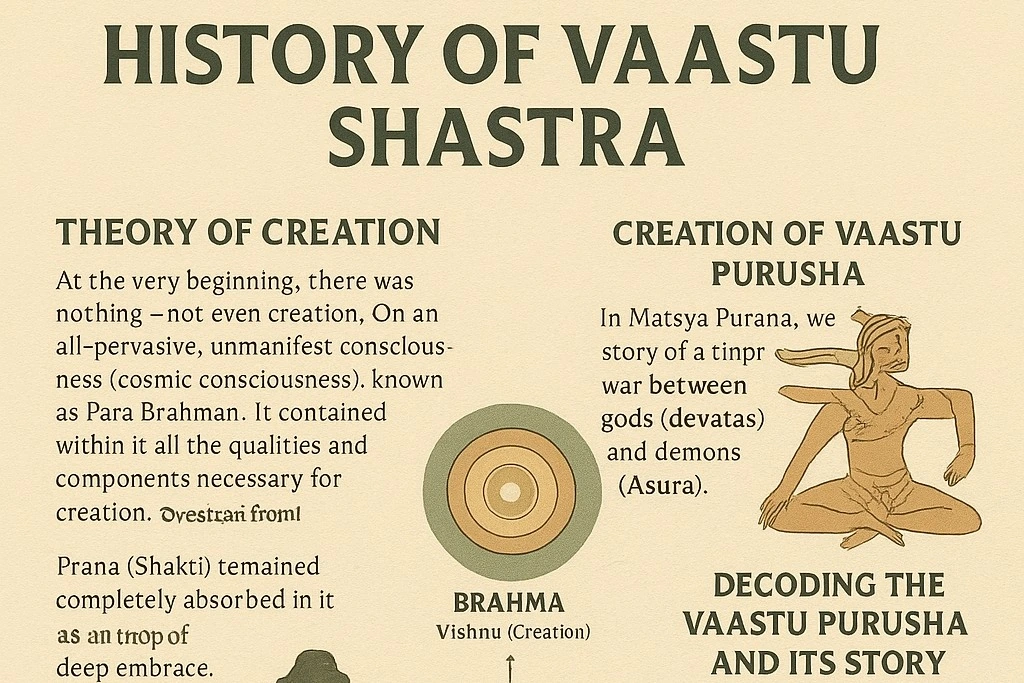
In this utter stillness, a movement occurred. A desire arose in that absolute principle:
EKOHAM BAHUSYAM – “I am alone, let me become many.”
This desire became the first creative consciousness, resulting in willing. This willing caused the first SPANDAN (Naad)—vibration—and energy emerged. This energy generated Shiva Tatva, the empty space that forms the base of all creation (Shiva is Anant, Shiva is in every being). As this Naad happened, the Shoonya became infinite, and Shiva Tatva as empty space was created. Along with it, the first moment of becoming from being manifested Prana (Shakti), called Mahaprana.
Prana was never separate from consciousness; it existed as potential. Now, it assumed form. Thus, energy and consciousness interacted and engaged in a cosmic play—LILA, which caused SHRISHTI (creation).
The unchanging consciousness experienced itself through the movement of Prana. Over time, modifications occurred in consciousness and Prana, giving rise to different levels of existence—beings, matter, elements, energies, light and dark, positive and negative, animate and inanimate, male and female.
Together, Consciousness and Prana expanded the universe and dissolved it at the end of each age, absorbing creation back into themselves.
Brahma, Vishnu and Mahesh
As Shiva–Shakti interactions began (Lila), Brahma (Universal Mind) was created and the entire creation unfolded through Brahma. Shiva and Shakti are the underlying energies, but Brahma is the medium.
Shiva is constant, Shoonya, yet omnipresent as Shiva Tatva. Shakti can take many forms and create. From their interaction, Shakti created Brahma, and through Brahma the universe unfolded.
Once Brahma was created:
From Brahma, the Space element emerged.
From Space came Water.
Water created Plant life, which produced Air.
Air generated Fire.
Fire created Earth (ashes).
Earth produced Metal, and vaporised metal returned to Space.
Thus, Brahma initiated the process of creation.
Vishnu maintains the universe. Shakti transforms and, with Shiva Tatva, manifests Vishnu, who is the soul of all beings.
Mahesh (Shiva) in the form of Shakti ends creation.
For any creation to occur, all three forces must be present:
Brahma – Rajas (Creation)
Vishnu – Satva (Flow)
Mahesh – Tamas (End)
Creation of Vaastu Purusha
According to the Matsya Purana, a fierce war took place between the devatas and asuras. Lord Shiva supported the devatas, while Andhakasur fought for the asuras.
During the war, drops of sweat from Shiva fell to Earth, giving birth to a giant, powerful male who terrified both devatas and asuras. They brought him to Brahma, who called him his Manas Putra and named him Vaastu Purusha.
Vaastu Purusha lay down in a specific posture. Some parts of his body were inhabited by devatas and others by asuras.
Brahma decreed that Vaastu Purusha must be honoured during construction of buildings, towns, temples, or ponds. Ignoring him would lead to troubles (asuras), while reverence would ensure support (devatas).
Decoding Vaastu Purusha and the Story
Lord Shiva represents super consciousness.
Andhakasur symbolizes darkness and ignorance.
The war between them represents the internal conflict within every individual in three koshas—Annamaya, Pranamaya, and Manomaya.
This inner churning gives rise to a system with both positive and negative aspects. When a person analyses their thoughts, super consciousness and internal conflict meet to define purpose. Buildings are created for this purpose; hence, the macro-force that creates the universe appears in the building.
Placing Vaastu Purusha symbolically within a structure represents this greater purpose.
“Yat Pinde Tat Brahmande” – as within, so without.
A house and a body function similarly at the energy level:
Three nadis,
Seven chakras,
An energy body.
Theory of Creation in a Land
When a land boundary is defined:
Shiva is established in the North-East,
Shakti in the South-West,
Mahashakti connects via the South-East,
Brahma is formed at the centre,
Energy body of Vaastu Purusha is created.
Since no construction is done yet, energy flow is minimal—like a small universe with all possibilities of future creation.
This mirrors human creation: In the womb, the energy body forms first. Shiva is established at Ajna, Shakti at Muladhar, universal energy enters through the Medulla Oblongata, and Brahma sits at the Navel.
Relevance of Lord Brahma
As the creator, Brahma is the root of all creation.
During conception, husband and wife represent Shiva and Shakti. The first event is the creation of Brahma (light yellow), followed by the formation of energy channels. Shiva establishes at Ajna, Shakti at Muladhar, Vishnu at Anahat.
Similarly, in Vaastu:
When land is marked, Shiva and Shakti are dormant.
At plinth level, Brahma forms at the centre, initiating energy development.
Mahashakti connects via the South-East.
Shiva establishes in NE, Shakti in SW.
When the door location is marked, Vishnu is established (as the door connects to the world).
Brahma’s Manas Putra
Brahma created four Manas Putras from his four faces—collectively called Vishwakarmas:
| Face of Brahma | Manas Putra | Contribution |
|---|---|---|
| East (Vishwabhu) | Vishwakarma | Architect of devas; wrote Vishwakarma Prakash |
| South (Vishwavid) | May | Architect of asuras; wrote Maymatam and May Samhita |
| West (Vishwashrishta) | Manu | His son Takshak mastered architectural skills |
| North (Vishwastha) | Tvashta | His son Vardhaki mastered Vedas and layout |
All architectural principles originate from these divine creators.
Relevance of Lord Vishnu
Lord Vishnu is the caretaker of the world and the soul of all beings.
At conception, Vishnu is established at the Anahat Chakra, the bridge between lower and upper chakras. For Shakti to rise and meet Shiva, Anahata must be balanced and open.
It opens when one understands and accepts their Pravritti—their true nature and purpose. This is why Lord Krishna’s teachings in the Bhagavad Gita guide individuals toward self-knowledge, success, and ultimately Moksha.
In Vaastu, Vishnu governs the main entrance. The door connects the house with the external world. An imbalanced entrance can negate all other Vaastu remedies, blocking both material success and spiritual progress.
Team Staarvani
We’re a team of astrologers and occult experts who love sharing the wisdom of the stars in simple, relatable ways. From Astrology and Numerology to Vastu and Tarot, we mix deep experience with a passion for storytelling, so you get content that’s both insightful and easy to enjoy. Staarvani is your astrology and numerology platform, offering personalized reports, love calculators by name, numerology calculator, and consultations via app and website.
Meet our powerful AI Astrologer - Vani AI
Ask your first question free with your personal AI astrologer — instant, accurate, and deeply personalized.