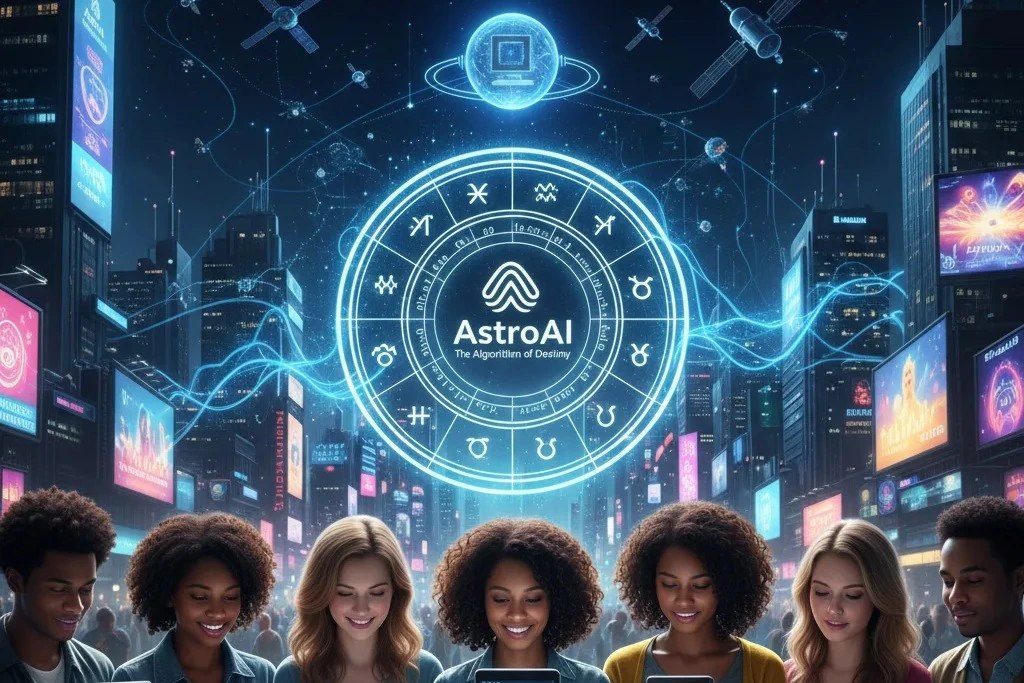
Years ago, reading your "daily horoscope" was a simple affair—a few sentences shared in a newspaper or maybe some broad online reading meant for everyone with the same zodiac sign. But things have changed. We are now in a time when astrology dives deeper than just your star sign. It analyzes the precise angles personal transits, and complex layers of your individual birth chart.
The growing availability of astro ai free tools and advanced ai astrology platforms isn’t about technology evolving. It marks a deeper shift in the way people look for meaning in the stars. From Sun Signs to Computational Birth Charts
The primary driver behind this boom is the move from "broad-stroke" astrology to hyper-personalization. Traditional horoscopes are limited by the manual effort required to calculate and interpret a single chart. An ai astrologer, however, can synthesize the positions of ten planets across twelve houses and dozens of mathematical aspects in milliseconds.
This allows for a level of depth that was previously reserved for expensive, private consultations. Today, an astrology ai app can cross-reference your natal placements with current planetary movements to explain why this specific Tuesday feels different for you than for another Scorpio born just three years later.
Why the Change is Happening Now
Interest in customized astrology readings has increased as people have gotten used to using digital tools. Generic predictions like "You will meet a stranger" no longer satisfy users. Many now want to know how the current Saturn transit in their 6th house could affect their job routines or well-being.
● Real-Time Updates: Digital astrology platforms change as as the planets do. A magazine column can't do that. If Mercury goes retrograde at 2:00 PM, the app will adjust your advice by 2:01 PM.
● Easy to Use: Understanding detailed Vedic or Western charts once demanded years of learning. Now, a free ai horoscope makes it simple for beginners to grasp tricky parts like Dashas or Midheavens without needing lots of study.
● Interactive Chats: With modern astrology chatbot tools, you can ask specific things like, "What does this Full Moon mean for my career?" This shifts it from just reading advice to having a conversation.
The Human Element in a Data-Driven Sky
Despite the efficiency of an ai based astrology system, the industry is reaching a consensus: data is the skeleton, but human experience is the soul. As practitioners who have watched these systems evolve, we recognize that while a computer can identify a square aspect between Mars and Pluto, it cannot feel the weight of a user's grief or the specific cultural nuances of their upbringing.
The most successful astrology ai tools are those that act as a bridge. They handle the "heavy lifting" of astronomical calculations and pattern recognition, leaving the user (or a human consultant) with the space to apply intuition and agency. The goal of a personalized horoscope shouldn't be to dictate a fixed destiny, but to provide a weather report for the soul—giving you the "algorithm" of the current energy so you can decide whether to carry an umbrella or bask in the sun.
Ethical Boundaries and User Agency
As we lean further into ai astrology app usage, the industry is grappling with responsibility. We must be transparent: these tools identify patterns and probabilities, not absolute certainties.
The best platforms today are moving away from "doom-scrolling" predictions toward empowering language. Instead of warning of a "financial disaster," an ethical system highlights a period of "potential fiscal restructuring," encouraging the user to take proactive control rather than feeling like a passive observer of their own life.
Navigating the Future of the Stars
The boom in astro ai represents a democratization of ancient wisdom. It brings the precision of the mathematician to the art of the mystic. Whether you are using a tool for a quick daily check-in or a deep dive into your life’s purpose, the value lies in the clarity it provides for the present moment.
The stars haven't changed, but our ability to hear what they are saying has never been more refined.

Team Staarvani
We’re a team of astrologers and occult experts who love sharing the wisdom of the stars in simple, relatable ways. From Astrology and Numerology to Vastu and Tarot, we mix deep experience with a passion for storytelling, so you get content that’s both insightful and easy to enjoy. Staarvani is your astrology and numerology platform, offering personalized reports, love calculators by name, numerology calculator, and consultations via app and website.
Meet our powerful AI Astrologer - Vani AI
Ask your first question free with your personal AI astrologer — instant, accurate, and deeply personalized.