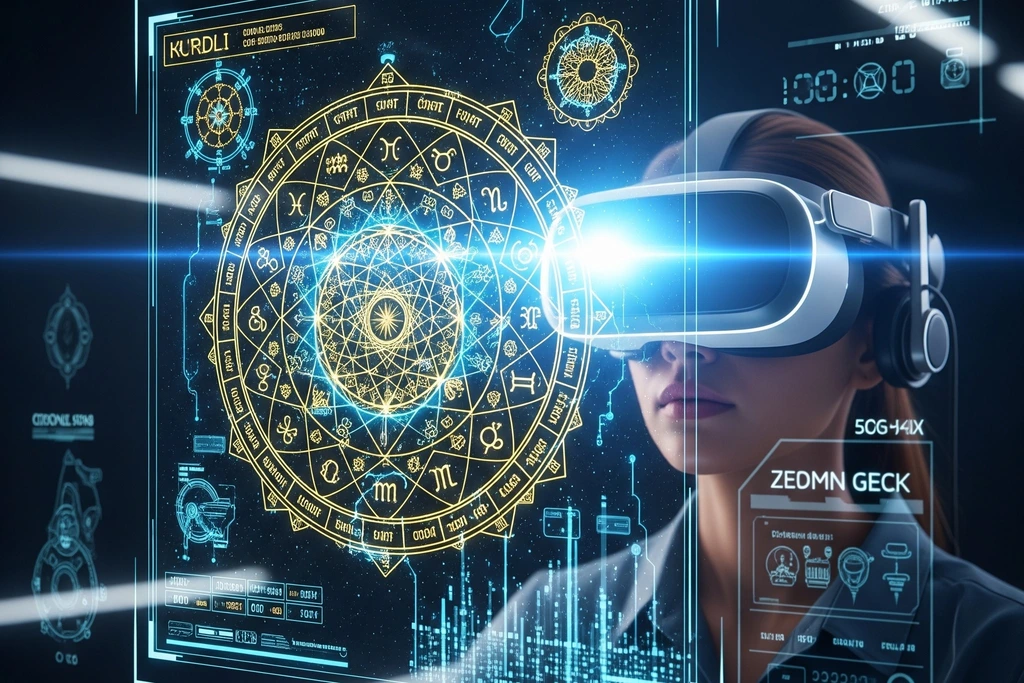
For many years, the world of Vedic astrology has stayed the same. People have viewed the Janma Kundli as a fixed map, whether it appeared as a handmade square in an old notebook or as a simple grid on a phone. It has always been a flat image showing a complex celestial event. However, the real limitation has never been astrology itself. The problem has been the ways we interact with it. Now, things are changing. Instead of just "reading" charts, technology is letting us "experience" them. Virtual reality and kundli gpt ai tools are coming together to build immersive environments where users can explore astrology in a new way.
From Flat Charts to 3D Celestial Spaces
The typical North or South Indian chart layout demands strong abstract thinking. Astrologers need to visualize the power of the Grahas, the distances between planets, and the intricate network of Drishti (aspects) in their minds. Most ai astrology platforms display this information in reports filled with text.
Using Virtual Reality lets us turn mathematical values into a spatial environment you can experience. Picture yourself positioned at the center of your Lagna (Ascendant). Instead of just reading that Saturn influences your Tenth House through its third aspect, you can perceive the planetary weight and angular relationships shown with lights and geometric designs. This isn't just about making things look good. The goal of vr kundli visualization is to make understanding these complex cosmic patterns easier to grasp by lessening the mental effort needed.
Curious about how these digital frameworks are evolving to handle traditional nuances?
Check this out:- (https://staarvani.com/service/love-calculator-by-name)
Read our latest deep dive on:- (https://staarvani.com/blog/when-will-i-get-married-astrology-by-date-of-birth)
The Precision of Data: Why AI Astrology Platforms are Redefining Personalization in B2B Ecosystems.
How High-Dimensional Data is Processed
The foundation of this experience is not just the visual headset but the ai-based kundli analysis behind it. The system processes huge amounts of ephemeris data to create a 3D environment that aligns with astrology.
When users interact with a kundli gpt ai model inside a virtual reality space, the system doesn’t create any new destiny. Instead, it combines and interprets existing patterns. It computes the Shadbala (six-fold strength) of a planet and represents that strength . The planet’s brightness or size in the simulation depends on this calculation. This feature lets users "move through" their timeline and see how Mahadashas direct the celestial energy from one area of the skies to another.
How Immersion Alters Interpretation
Our editorial team noticed a clear shift in how people understand information when presented. Static charts cause "fragmented thinking," where users concentrate on a single planet alone. Immersive vedic astrology ai inspires "systems thinking."
● Spatial Context: Observing the gap between Rahu and the Moon across a full 360-degree path brings the idea of Grahan Yoga to life more than reading it in words.
● Temporal Navigation: Users can move through time seeing how the transits shift through their houses like changing weather helping them grasp cosmic patterns more.
● Interactivity: Tapping on a specific house unveils its Bhavat Bhavam (house-to-house) relations creating an engaging and hands-on way to learn.
The Human-Centered Limit
Although kundli AI tools are advanced, we should separate data presentation from true wisdom. An engaging astrology experience may explain the "where" and "how much," but understanding the "why" still remains a human task. The role of technology is to simplify intricate chart interpretations allowing the user and astrologer to explore meaningful insights together.
Looking ahead to the future of Vedic astrology, the aim is not to replace the intuition of skilled astrologers but to enhance their perspective with better tools. Instead of relying on predictive systems that feel mysterious, we are adopting clear and visual methods that respect the precise mathematics found in the Vedas.
Asked Questions
How does VR make traditional Kundli reading better?
VR shifts the chart from a flat 2D surface into a 3D environment. It lets users view planetary positions and strengths through things like physical spacing and brightness levels. This change helps people understand complex connections more .
Can Kundli GPT AI take the place of a human astrologer?
It can't. Kundli GPT AI does well at doing calculations and showing data , but it doesn't have the real-life understanding and deep empathy needed to provide complete counseling or ethical advice.
What equipment do you need to view VR Kundli?
Right now, advancements are focused on premium VR headsets and online XR platforms. These tools are necessary to process data in real-time and create accurate visual displays of celestial arrangements.
Can AI-driven kundli tools manage tough calculations like Ashtakavarga?
Yes, AI astrology tools are built to handle heavy mathematical processes such as Ashtakavarga and Varga charts. These can also be integrated into a virtual reality setup for visualization.
Team Staarvani
We’re a team of astrologers and occult experts who love sharing the wisdom of the stars in simple, relatable ways. From Astrology and Numerology to Vastu and Tarot, we mix deep experience with a passion for storytelling, so you get content that’s both insightful and easy to enjoy. Staarvani is your astrology and numerology platform, offering personalized reports, love calculators by name, numerology calculator, and consultations via app and website.
Meet our powerful AI Astrologer - Vani AI
Ask your first question free with your personal AI astrologer — instant, accurate, and deeply personalized.